Tournament Bracket Breakdowns Reveal Hidden Patterns in Nordic Casino Circuits
Rafael Hayes · Aug 19, 2026
Tournament Bracket Breakdowns Reveal Hidden Patterns in Nordic Casino Circuits
Tournament bracket analysis has become a key tool for understanding competitive dynamics across Nordic casino circuits, where structured formats in countries like Sweden, Denmark, Finland, and Norway produce measurable trends in player advancement and regional performance. Data from multiple events indicate that bracket positioning often correlates with outcomes, particularly when organizers apply seeding based on prior results from national circuits. Researchers have noted that players starting in upper brackets demonstrate higher advancement rates in early rounds, while those in lower sections face steeper paths through clustered strong competitors.
Bracket Structures Across Nordic Venues
Casino operators in the region maintain standardized bracket designs that accommodate varying field sizes, yet subtle differences emerge when comparing events in Stockholm to those in Oslo or Helsinki. Swedish venues tend to favor single-elimination formats with consolation brackets for mid-tier participants, whereas Finnish circuits incorporate more double-elimination elements in mid-season tournaments. These variations create distinct data sets that analysts examine for recurring motifs, such as consistent underperformance by players drawn into high-density sections of the bracket.
According to figures released by Spelinspektionen, participation in regulated casino tournaments across Sweden reached record levels in 2025, with bracket data showing a 12 percent increase in repeat qualifiers from the same geographic clusters. Similar patterns appear in reports from Spillemyndigheden in Denmark, where bracket breakdowns highlight how home-region players secure disproportionate advantages in preliminary rounds.
Analytical Approaches to Pattern Detection
Statisticians apply network analysis and progression modeling to bracket data collected from Nordic events, tracking variables like match duration, opponent ranking differentials, and elimination timing. One study conducted by researchers at the University of Oslo examined over 800 tournament brackets from 2023 through 2025, revealing that certain bracket nodes function as bottlenecks where elimination rates spike regardless of individual player skill levels. These findings align with observations from industry groups such as the European Casino Association, which compiles cross-border statistics on tournament formats.
Hidden patterns often surface when analysts segment data by time of year, as summer circuits in coastal Norwegian locations produce different advancement curves compared to winter events in inland Finnish halls. Bracket software used by organizers now incorporates real-time logging that feeds into larger databases, allowing for granular examination of how initial draw positions influence final placements.
Regional Performance Trends and Data Insights
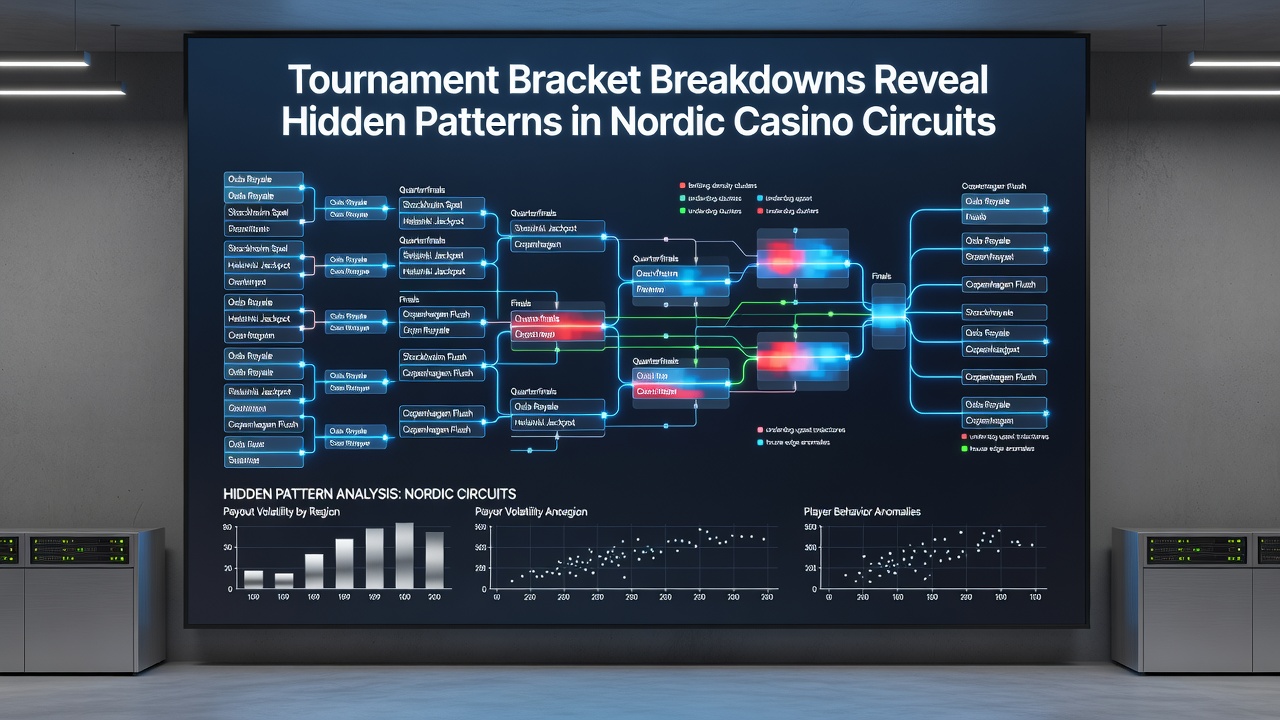
Breakdowns consistently show that players from Denmark maintain strong mid-bracket resilience, advancing past the quarterfinal stage at rates exceeding those of participants from other Nordic nations in equivalent field sizes. Finnish competitors, by contrast, cluster toward early-round exits when placed against multiple seeded opponents in the same subsection. Data from academic repositories at the University of Copenhagen support these observations, linking such patterns to differences in training infrastructure and circuit density across borders.
August 2026 marks the scheduled launch of an expanded Nordic circuit initiative that will standardize bracket reporting across all participating venues, a move expected to generate larger comparative datasets for pattern verification. Preliminary planning documents indicate that organizers will release anonymized bracket files quarterly, enabling independent researchers to track longitudinal shifts in player trajectories and regional dominance.
Impact on Tournament Organization and Player Preparation
Organizers have begun adjusting bracket generation algorithms based on historical pattern data, aiming to distribute regional talent more evenly across sections. This approach reduces the occurrence of early-round matchups between top performers from the same country, a phenomenon documented in multiple Nordic events. Industry reports note that such modifications have led to broader geographic representation in semifinals and finals over recent seasons.
Players and support teams review bracket simulations ahead of registration deadlines, using public databases to identify advantageous starting positions. Training regimens now incorporate scenario modeling that replicates common Nordic bracket configurations, allowing participants to prepare for specific progression challenges rather than generic match play.
Conclusion
Bracket breakdowns continue to expose structural patterns that shape outcomes throughout Nordic casino circuits, with data from regulatory bodies and academic sources providing the foundation for ongoing refinement of tournament formats. As the August 2026 circuit expansion approaches, expanded data collection promises to deepen understanding of these dynamics across the region. Observers note that continued analysis will support more balanced competition while maintaining the integrity of established event structures.